
You have a new client who needs SEO support. Your team can handle the strategy and client relationship, but the technical audit will take more time than you have available. Or perhaps your agency offers web design, PPC, or content marketing and wants to add SEO without building an entire department first.
White-label SEO gives you another option.
White-label SEO is an arrangement where an external SEO specialist or provider completes SEO work on behalf of an agency, while the agency provides the service under its own brand. The agency keeps the client relationship, while the white-label partner works behind the scenes on the agreed SEO deliverables.
That could mean one technical audit, support during a website migration, or ongoing work across several client accounts. You don’t have to hand over your entire SEO operation for the arrangement to work.
How Does White-Label SEO Work?
A white-label SEO arrangement starts with deciding what your agency wants to keep in-house and where you need support.
For example, your team might already have account managers, content writers, and developers but no dedicated technical SEO specialist. In that case, your white-label partner could handle technical audits and QA while your existing team handles everything else.
Another agency might need someone who can take ownership of most of the SEO delivery while its account managers remain client-facing.
There isn’t one setup that works for every agency. What matters is having clear responsibilities from the beginning.
1. Your Agency Decides Where It Needs Support
Start with the gap you’re trying to fill.
Maybe your SEO team has reached capacity. Perhaps a new client needs expertise your current team doesn’t have. Or you have a large project coming up, such as a site migration, that temporarily requires another pair of hands.
The scope could include a single task, a project, or ongoing work across several accounts.
Getting specific at this stage matters. “We need help with SEO” leaves a lot open to interpretation. “We need someone to audit this site, prioritize the findings, and QA the fixes after our developer implements them” gives everyone a much clearer starting point.
2. You Agree on Responsibilities and Handoffs
Before work starts, both sides should know who owns what.
If a technical audit identifies changes that require development work, who sends those recommendations to the developer? Who checks the implementation? Who updates the client?
The same applies to reporting. Your white-label partner might prepare the analysis while your account manager presents it. In another setup, the partner may only provide the data and notes your team needs to build its own report.
This is also the point to agree on deadlines, communication channels, deliverable formats, approval processes, and whether the partner will ever interact with clients.
Clear handoffs make white-label SEO much easier to manage.
3. The SEO Partner Works Behind the Scenes
Once the scope is clear, the white-label partner completes the agreed work as part of your agency’s delivery process.
That might involve crawling a client website, investigating an indexation problem, building a keyword map, reviewing internal links, preparing content briefs, checking schema, or monitoring search performance.
A good white-label relationship shouldn’t require your team to constantly translate or rebuild the work before it can be used.
If your agency has templates, naming conventions, project management systems, or specific ways of presenting recommendations, the partner should be able to work within those processes.
4. The Work Comes Back to Your Agency
In a traditional white-label arrangement, your agency remains the primary point of contact for the client.
The completed work may be delivered without the external provider’s branding or prepared using your agency’s preferred templates. Your team can then review it, add any necessary context, and present it to the client.
This allows you to add capacity without changing the relationship you’ve already built with your clients.
5. Support Changes as Your Workload Changes
White-label SEO doesn’t have to mean signing up for a large monthly package.
An agency might need help with one technical audit this month and nothing the next. Another might need ongoing support across five accounts.
Common arrangements include:
- One-off support for audits, keyword research, content strategy, or technical investigations
- Project support for migrations, site restructures, technical cleanups, or large optimization projects
- Ongoing support for agencies that regularly need help with technical SEO, on-page work, monitoring, reporting, or content strategy
- Overflow support when an internal SEO team temporarily has more work than it can reasonably handle
The right arrangement depends on what your team already does well and where additional capacity would make delivery easier.
What SEO Work Can Agencies White-Label?
Almost any part of SEO delivery can be supported externally, but that doesn’t mean you should outsource everything.
Common white-label SEO services includes:
- Technical SEO audits
- Crawl and indexation analysis
- Keyword research and mapping
- On-page optimization
- Internal linking
- Schema markup
- Content strategy and SEO briefs
- Website migration support
- Technical implementation QA
- Google Search Console analysis
- Search performance monitoring
- SEO reporting
- AI search visibility analysis
Think about a web development agency preparing to launch a redesigned client site. Its developers can handle the build, but the agency may want an SEO specialist to review redirects, canonicals, internal links, indexability, metadata, structured data, and other search considerations before and after launch.
The agency doesn’t need to hire a full-time technical SEO specialist for that project. It needs the right expertise at the right point in the project.
The same applies to agencies that already have SEO teams. White-label support can fill a specific gap rather than replace the people already doing the work.
What Are the Benefits of White-Label SEO for Agencies?
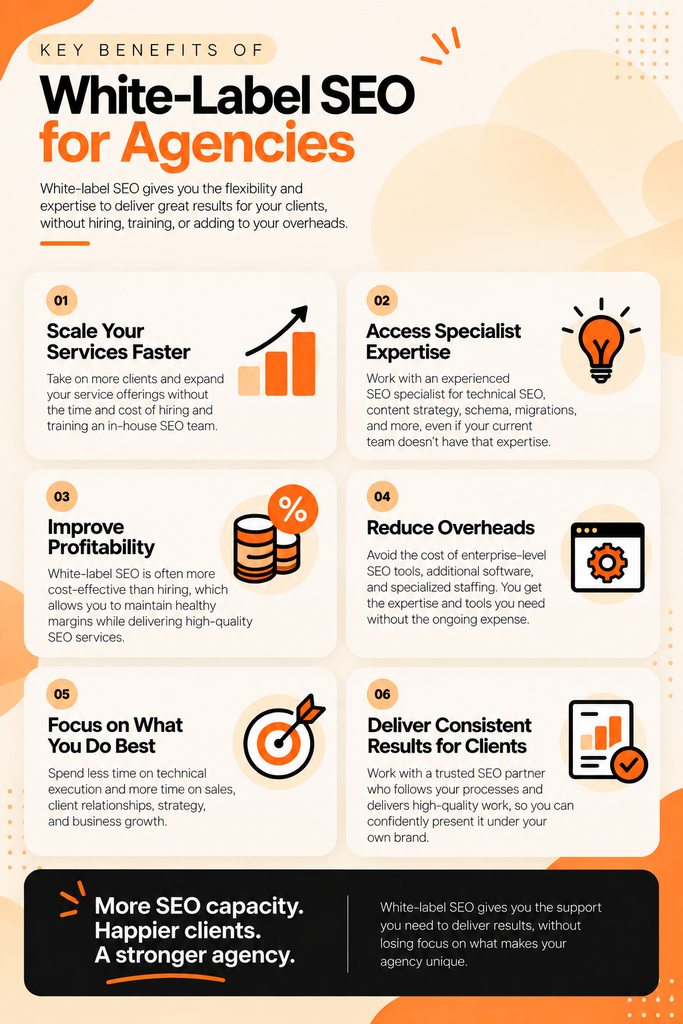
White-label SEO can give an agency more capacity without requiring it to build every SEO capability in-house. The exact benefit depends on what your team already handles and where the gaps are.
Take On More Work Without Immediately Hiring
Signing a new SEO client is good news until you realize your existing team is already working at capacity.
Recruiting another employee may make sense when the workload is predictable and long-term. It makes less sense when you’re responding to a temporary increase in work or you’re still figuring out how much demand there will be.
White-label support gives you another way to increase delivery capacity without making an immediate full-time hire.
Bring In Specialist Expertise When You Need It
SEO covers several disciplines, and your team doesn’t need to be equally strong in all of them.
You may have excellent content strategists but need help diagnosing an indexation problem. Your developers may be preparing a migration but need someone to handle SEO QA. Your SEO team may simply need a second set of eyes on a complicated technical issue.
A white-label partner lets you bring that expertise into the project while keeping the rest of the work with your existing team.
Expand Your SEO Services
Web development, content, PPC, branding, and full-service marketing agencies often receive SEO requests even when SEO isn’t their main service.
White-label support can help you take on those projects without having to build an SEO department before you know whether there is enough demand to justify one.
You can start with the services clients are actually asking for and expand from there.
Keep Your Internal Team Focused
Not every SEO task needs to land on the desk of your most senior strategist.
Technical checks, keyword mapping, content briefs, reporting, QA, and other delivery work can take significant time across several accounts.
Moving agreed tasks to a white-label partner can give your internal team more room for client communication, strategy, account management, and the work that specifically needs their involvement.
Adjust Support Around Your Workload
Agency workloads aren’t always predictable.
You might need additional support for three audits this month, one migration the next, and then ongoing help with several client accounts.
White-label arrangements can be structured around one-off tasks, specific projects, overflow work, or recurring delivery. That makes it easier to match the level of support to the work actually coming through your agency.
Keep the Client Relationship With Your Agency
Bringing in outside expertise doesn’t have to mean handing over the client.
In a white-label setup, your agency can continue to manage communication, strategy, and the overall relationship while the SEO partner completes agreed work behind the scenes.
The client continues working with the agency they hired, while your team gets additional support delivering the work.
White-Label SEO vs. SEO Outsourcing
White-label SEO is a form of outsourcing, but the terms aren’t always interchangeable.
| White-label SEO | Traditional SEO outsourcing |
|---|---|
| Work is delivered as part of your agency’s service | Provider may deliver services under its own brand |
| Your agency usually owns the client relationship | Provider may have a direct relationship with the client |
| Work can follow your agency’s processes and templates | Provider may use its own processes and systems |
| Partner can remain behind the scenes | Outsourced provider may be visible to the client |
| Designed to fit into your existing delivery model | May operate as a separate vendor relationship |
The main distinction is how the external provider fits into your agency-client relationship.
If your agency hires an SEO consultant and introduces that person to the client as an independent consultant, that’s outsourcing, but it isn’t necessarily white-label SEO.
If that specialist completes the work behind the scenes as part of the service your agency provides, that’s a white-label arrangement.
When Does White-Label SEO Make Sense for an Agency?
You don’t necessarily need white-label support simply because your agency offers SEO.
It becomes useful when there’s a gap between what your clients need and what your current team can comfortably deliver.
Your SEO Team Is at Capacity
Your agency signs two new clients, but your existing SEO specialists are already managing full workloads.
You could turn the work away, stretch the team further, or start recruiting. Another option is to bring in outside support for the additional delivery work while your internal team keeps ownership of the accounts.
A Client Needs Expertise You Don’t Have In-House
Someone who is excellent at content strategy may not be the person you want troubleshooting a complicated indexation issue.
Likewise, a developer who understands site performance may not necessarily know what to check during an SEO migration.
A white-label specialist can fill that specific gap without replacing the people already working on the account.
You Want to Add SEO to Your Services
A web design, content, branding, or PPC agency may start receiving SEO requests before it has a dedicated SEO team.
Working with a white-label specialist gives you a way to test and develop the service based on actual client demand rather than building a department first and hoping the work follows.
You Have a Large One-Off Project
Some projects create a temporary spike in workload.
A large migration, technical cleanup, site restructure, or portfolio-wide audit might require far more SEO time than your team normally needs.
Additional support during that period can keep the project moving without pulling your internal team away from every other client account.
What Should Stay With Your Agency?
Outsourcing execution doesn’t mean giving up control of the account.
Your agency should remain clear about what you’ve promised the client, the scope of the engagement, deadlines, approval processes, and who is responsible for final decisions.
The white-label partner also needs enough context to do good work.
For example, a recommendation that makes perfect SEO sense may be unrealistic if it ignores the client’s development resources, CMS limitations, or business priorities. Sharing that context helps the partner make recommendations your team can actually use.
White-label SEO works best when the external specialist feels like part of the delivery process rather than someone receiving isolated tasks with little information.
Does the Client Need to Know You’re Using White-Label SEO?
Not necessarily. It depends on your agency’s agreements and how you choose to work with external partners.
Some white-label specialists work completely behind the scenes. The agency handles every client conversation and presents the work under its own brand.
Other arrangements are more collaborative. A specialist might occasionally join a technical meeting, answer questions from a development team, or provide expertise during a complicated project.
What’s important is deciding the boundaries before the work begins.
If the arrangement is meant to be fully white-label, your partner needs to understand that. If you expect them to join client calls or communicate with developers, that should also be agreed upon from the beginning.
What Should You Look for in a White-Label SEO Partner?
SEO knowledge matters, but it’s only part of the relationship.
Your partner is contributing to work that ultimately carries your agency’s name, so you also need to know whether they can fit into the way your team works.
Look at:
- The type of SEO work they actually have experience handling
- How clearly they communicate recommendations
- Whether they explain why something should be prioritized
- Their approach to quality control
- How they handle deadlines and changing workloads
- Whether they can work within your existing processes
- How they handle confidential client information
- Whether their capacity matches the amount of work you expect to send
Ask to see examples of their work where possible.
A long list of SEO services doesn’t tell you much about what it will actually be like to work together. An example audit, case study, reporting sample, or explanation of their process usually tells you more.
White-Label SEO Should Make Delivery Easier
The point of bringing in white-label SEO support is to give your agency capacity or expertise it doesn’t currently have available.
It shouldn’t leave your account managers rewriting every recommendation, your developers trying to interpret vague audit notes, or your SEO lead spending hours correcting work before it reaches the client.
The strongest setup is one where responsibilities are clear, communication is straightforward, and the work fits naturally into the way your agency already delivers SEO.
At FIXMYSERPs, I work behind the scenes with digital marketing agencies that need additional SEO capacity, whether that’s support with a specific project or ongoing work across client accounts. Contact me today to learn how we can work together with your digital marketing agency.