
Two new clients sign this month. Both need technical audits, and one has a migration scheduled. Your SEO lead is already juggling client reporting and developer questions. Should you hire another specialist or bring in outside help?
The decision starts with the work itself: how often it comes in, what expertise it requires, and who will manage delivery.
Hiring in-house suits agencies with steady SEO demand and a need for day-to-day involvement. Outsourcing can make sense for specialist projects, temporary capacity gaps, or work that doesn’t justify a permanent role. Many agencies need a combination.
Here’s what to compare before committing your budget.
What Is the Difference Between In-House SEO and Outsourcing?
In-house SEO means employing SEO specialists directly within your agency. They work as part of your internal team, follow your processes, and manage the SEO responsibilities assigned to them.
SEO outsourcing involves hiring an external specialist, freelancer, consultant, or agency to handle specific SEO tasks or projects.
For example, your agency might have an in-house SEO manager who oversees client strategies but outsource technical audits, content briefs, or migration support when the team needs additional help.
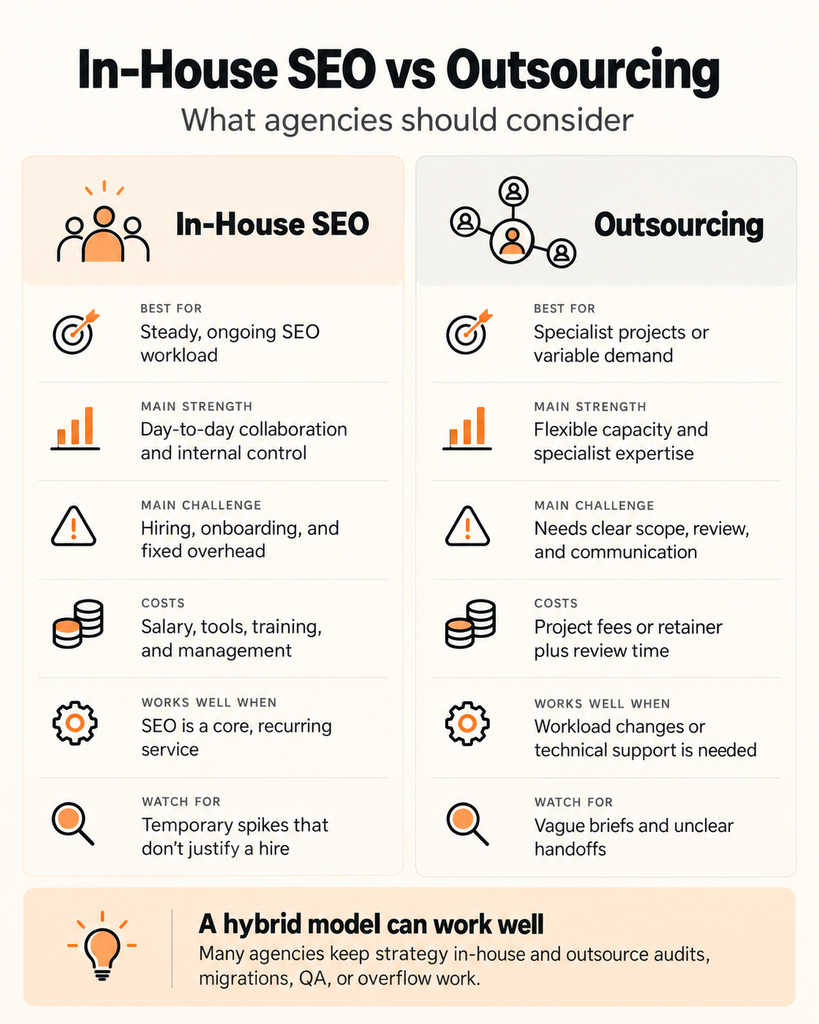
The key difference is who employs the specialist and how the agency organizes and reviews the work. Use this comparison as a starting point.
The deciding factors are consistent demand, available skills, and a review process that lets recommendations reach implementation.
When Does Hiring an In-House SEO Specialist Make Sense?
Hiring internally often makes sense when your agency has consistent SEO demand and enough work to keep someone meaningfully occupied.
An in-house specialist becomes familiar with your clients, internal systems, reporting requirements, and the way your agency approaches SEO. That familiarity is particularly useful when several accounts require ongoing attention.
Your Agency Has Predictable SEO Work
If your agency regularly handles technical SEO, content strategy, on-page optimization, and reporting across multiple accounts, you may have enough work to justify a dedicated employee.
Consider an agency with several ongoing SEO retainers. Every month brings reporting, technical monitoring, prioritization, and discussions with account managers. Those recurring responsibilities may support an internal role.
Before hiring, separate that routine workload from temporary spikes. Three simultaneous website launches can make a month feel like a permanent staffing problem when it isn’t.
SEO Is a Core Part of Your Agency’s Offering
If SEO accounts for a significant part of your agency’s services, experienced specialists internally can help develop consistent processes.
An in-house SEO lead can oversee client strategy, review recommendations, manage delivery standards, and coordinate with other departments. This is useful when your agency needs someone making SEO decisions across multiple accounts every day.
You Need Someone Available for Daily Collaboration
Some agencies require frequent communication between SEO specialists, developers, writers, designers, and account managers.
Having someone inside the business can make these conversations easier, particularly when priorities change throughout the day. However, availability alone shouldn’t determine whether you hire. Consider whether the role requires full-time involvement or planned external support.
What Are the Challenges of Building an In-House SEO Team?
An internal SEO team gives agencies control, but building and maintaining that team requires resources beyond the employee’s salary.
Hiring Takes Time
Finding someone with the right SEO experience can take longer than expected. You need to evaluate technical knowledge, problem-solving, communication, and ability to work with your existing team.
Even after hiring, onboarding takes time. If a migration starts next week, hiring someone new may not solve the immediate problem.
One Specialist May Not Cover Every Area of SEO
Someone excellent at keyword research and content strategy may have limited experience with JavaScript rendering, large-scale indexation problems, or complex website migrations.
Similarly, a technical SEO specialist may not be the right person to manage every aspect of content production. As your services expand, relying on one person for every SEO requirement can create gaps.
Client Workloads Change
Some months bring new client onboarding, migrations, and urgent technical problems. Others involve routine optimization and reporting.
Hiring based on a temporary increase in demand can leave unused capacity later. Consistently understaffing can create delays and rushed reviews. The decision needs to account for both.
When Should an Agency Consider Outsourcing SEO?
Outsource when you can define the deliverable, deadline, and person who will review the work. It works especially well when a project needs expertise your team rarely uses or when client demand temporarily exceeds capacity.
Your Team Has More Work Than It Can Deliver
Imagine your agency has an SEO strategist, two content writers, and a developer. The strategist handles keyword research, content planning, reporting, and technical audits. Then three new accounts arrive in the same month.
Instead of hiring immediately, you could outsource the audits and keep strategy, reporting, and client communication internally. That gives your existing team more room to focus on the responsibilities they already own.
A Project Requires Specialist SEO Knowledge
A website migration may only happen occasionally at your agency, but a single missed redirect or noindex directive can create substantial cleanup work.
Developers may know how to migrate a website, but SEO migration checks involve redirects, canonical tags, internal links, indexability, and post-launch monitoring.
An external technical SEO specialist can review the plan before launch and check the live site afterward. Your team still owns launch decisions and developer implementation.
You Want to Test Demand Before Hiring
Suppose your agency specializes in web design but has started receiving requests for ongoing SEO.
An external SEO provider allows you to establish a delivery process and learn what clients need before committing to a new role. If SEO becomes a predictable part of the business, revisit hiring with a better understanding of the workload.
You Need Support for a Defined Period
An SEO team member may be on leave, several clients may need work simultaneously, or a large project may require additional attention for a few weeks.
Outsourcing can cover that defined workload without restructuring your internal team.
What Are the Challenges of Outsourcing SEO?
Outsourcing still needs a clear brief, a point of contact, and a way to review the work. Without those, the time saved on execution can disappear into follow-up questions.
Unclear Responsibilities Create Delays
If you outsource a technical audit, who turns findings into development tickets? Who answers developer questions? Who checks fixes after implementation?
Define what the specialist delivers and where their responsibility ends before work starts.
Quality Can Vary Between Providers
One specialist may investigate affected pages and give prioritized recommendations. Another may forward a crawler export with no explanation of which issues matter.
Review previous work where possible. For technical SEO, look for reasoning and prioritization. For content, check that briefs show search intent understanding rather than keyword lists alone.
Communication Needs Structure
External specialists may not always be available for immediate conversations. That is manageable with agreed deadlines, updates, and escalation procedures.
Use your existing project management system to assign tasks, document questions, and review deliverables.
How Much Does In-House SEO Cost Compared to Outsourcing?
Comparing an employee’s monthly salary with a freelancer’s project fee doesn’t tell you the full cost.
For an in-house specialist, consider salary, employer-related costs, recruitment, onboarding, tools, training, management, and available productive work.
For outsourced SEO, consider provider fees, briefing time, review time, communication, and required implementation.
The comparison becomes more useful when you calculate what your agency needs to deliver over a specific period.
Example: A Technical SEO Workload
Suppose your agency needs technical audits for four new client websites. Ask:
• How many hours will the audits and recommendations require?
• Will there be enough similar work next month?
• Who will manage implementation and QA?
• Does your team have the skills to review the work?
• Could an external specialist complete this specific workload?
If the work is temporary, outsourcing may be easier to justify. If you consistently need audits, implementation, and monitoring across many accounts, hiring may become more practical.
Compare the full cost of delivering the required work, including management and QA time. A lower quoted fee isn’t useful if your team has to redo the deliverable.
Should Agencies Outsource SEO or Hire Freelancers?
Freelancers and white-label SEO providers can both support agency work, but the engagement model matters more than the label.
A freelancer may handle a specific task independently. A white-label SEO specialist may also be a freelancer, but works in an arrangement where the agency delivers the service under its own brand.
A larger provider may offer packaged services or multiple specialists.
Before choosing, clarify:
• Will the provider follow your agency’s processes?
• Can deliverables be supplied without external branding?
• Who communicates with the client?
• Is the work handled by a named specialist or a wider team?
• Who owns revisions and QA?
• What happens when the workload increases?
For agencies with account managers and SEO strategists, an individual specialist may be sufficient. A large delivery workload may need a provider with broader capacity.
Related reading: What Is White-Label SEO and How Does It Work for Agencies?
Can You Combine In-House SEO With Outsourcing?
Yes. Many agencies can keep core SEO responsibilities internally while outsourcing selected tasks.
You might have an in-house SEO lead responsible for strategy and prioritization, with external specialists supporting technical audits, migrations, implementation QA, or content research.
What Could a Hybrid SEO Team Look Like?
In-house SEO lead: Owns strategy, prioritizes client work, and reviews recommendations.
Internal content team: Creates and updates content from approved briefs.
Development team: Implements website changes.
External technical SEO specialist: Investigates technical issues, prepares recommendations, supports implementation, and performs agreed QA.
Each person has a defined responsibility. The external specialist adds capacity without taking over the entire account.
How Should Your Agency Decide Between Hiring and Outsourcing?
Start with the last three to six months of assignments. Which tasks repeat, which arrive unpredictably, and which keep getting pushed back?
1. Review Your SEO Workload
Separate recurring responsibilities from one-off projects and identify tasks that repeatedly get delayed.
Consistent overload may justify hiring. Significant variation between months may suit external support.
2. Identify the Skills You Already Have
List work your team handles confidently and where it needs expertise. An agency strong in content strategy but lacking technical SEO implementation support may not need another generalist.
3. Consider Who Will Manage the Work
Both employees and external specialists need direction. If nobody can review SEO recommendations or make strategic decisions, outsourcing isolated tasks without oversight may create problems.
4. Calculate the Cost Against Real Demand
Compare employment costs with project or retainer costs over a realistic period. Include management, review, and collaboration time.
5. Think About the Next Six to Twelve Months
Are you expecting predictable SEO account growth? Are projects arriving irregularly? Are you expanding into new services?
Account for the direction of the agency while leaving room to adjust.
A Practical Decision Checklist for Agency Owners
Use these questions before choosing how to add SEO capacity.
☐ Do we have enough recurring SEO work to justify another employee?
☐ Are current delays caused by workload, missing expertise, or inefficient processes?
☐ Which SEO tasks must remain under internal control?
☐ Which tasks could be handed over with a clear scope?
☐ Do we have someone qualified to review external recommendations?
☐ Can we afford the full cost of hiring, not just salary?
☐ Would external support fit our existing systems?
☐ Will the provider be available when projects require them?
☐ Do we need help for one project or across multiple client accounts?
If most work is recurring, scope an internal role. If gaps are project-specific, test external support with one defined deliverable. Revisit the decision after you know how much time the arrangement actually saves.
Frequently Asked Questions About In-House SEO and Outsourcing
Is it cheaper to outsource SEO than hire in-house?
It depends on the amount of work, provider fees, employment costs, and the time needed to manage delivery. Outsourcing can be cost-effective for defined projects or variable workloads. Hiring may make more financial sense when there is enough consistent work to use an employee’s capacity.
Can an agency outsource SEO without losing control of its clients?
Yes. With a white-label arrangement, your agency can retain client communication, strategy, pricing, and approvals while an external specialist handles agreed SEO tasks behind the scenes.
What SEO tasks are easiest to outsource?
Tasks with clear deliverables are often easier to outsource, including technical audits, keyword research, content briefs, schema reviews, on-page recommendations, and defined migration checks. Ongoing work can also be outsourced when responsibilities and reporting expectations are agreed.
When should an agency hire an in-house SEO specialist?
An internal hire may make sense when your agency has predictable ongoing SEO demand, enough work to support the role, and a need for regular internal collaboration or strategic oversight.
Can outsourced SEO specialists work with in-house teams?
Yes. External specialists can work alongside SEO leads, writers, developers, and account managers. The arrangement works best when tasks, communication, approvals, and QA responsibilities are clear.
Need Additional SEO Capacity Without Hiring Right Away?
Have a technical audit waiting, a migration approaching, or several deliverables sitting with an overloaded SEO lead? You can start by handing over one clearly scoped piece of work.
At FIXMYSERPs, I support digital marketing agencies with technical SEO, content briefs, migrations, and implementation QA. I work within your existing handoffs while your agency keeps the client relationship. Contact me today to discuss your SEO workload and how I can support your agency without the need for another full-time hire.